Introduction: “It’s Not Pending. It Doesn’t Take This Long to Pend.”
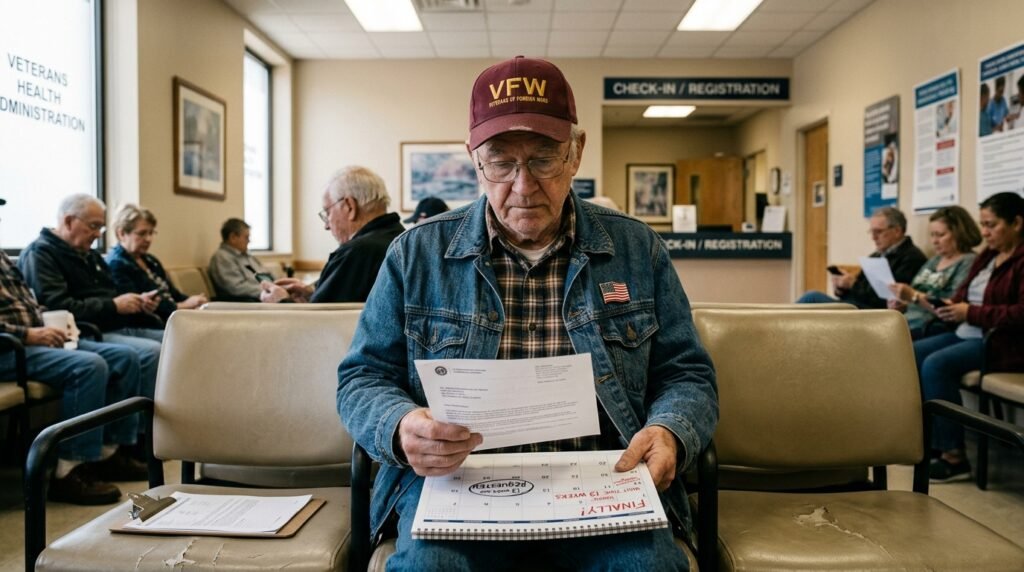
Richard Mulligan is 81 years old, a former Marine combat medic, and a disabled veteran. When he ended up in the emergency room with debilitating back pain, ER doctors gave him a clear, unambiguous instruction: get a follow-up appointment within 24 hours.
It never happened.
Instead, as WSB-TV Channel 2 Consumer Investigator Justin Gray reported, Mulligan waited 13 weeks to see a primary care doctor through the Atlanta VA Health Care System. “Everybody I spoke to, daily in the beginning, said it’s pending,” Mulligan recounted. “I said, ‘It’s not pending. It doesn’t take this long to pend.’” At one point, VA staff told him flatly: “No, we can’t see you. There’s not an opening. We cannot see you until September” — a response he received in June.
Rather than continue waiting, Mulligan made a decision that a growing number of American veterans and seniors are being forced to make: he paid out of pocket for private care. That decision likely saved his life. The private evaluation led to a diagnosis of prostate cancer — a diagnosis that, by his own account, might have come far too late had he continued to wait on the VA system.
His church is now helping cover the cost of treatment outside the VA network.
Mulligan’s case isn’t an isolated horror story. It’s a window into a systemic, well-documented pattern affecting hundreds of thousands of veterans and seniors across the country — one with clear rules on paper that frequently break down in practice. This article breaks down exactly what those rules are, what independent government watchdogs have found, and — most importantly — exactly what you or a veteran in your life should do if you find yourself in Richard Mulligan’s position.
Systemic Analysis: How the VA MISSION Act Is Supposed to Work — And Where It Breaks Down
The Rules on Paper: 20 Days, 28 Days
Since 2019, the VA MISSION Act has governed when veterans are legally entitled to seek care outside the VA system through the Veterans Community Care Program (VCCP). According to the VA’s own official eligibility guidance, a veteran qualifies for outside “community care” if any of the following apply:
- Primary care, mental health care, or non-institutional extended care: the VA cannot offer an appointment within 20 days of the request, or the average drive time to the nearest qualifying VA facility exceeds 30 minutes
- Specialty care (such as cardiology or oncology): the VA cannot offer an appointment within 28 days, or the average drive time exceeds 60 minutes
- The specific care needed isn’t available at any VA facility
- The veteran lives in a state or territory without a full-service VA facility (Alaska, Hawaii, New Hampshire, Guam, American Samoa, the Northern Mariana Islands, or the U.S. Virgin Islands)
- The veteran and their VA provider jointly determine that outside care is in the veteran’s best medical interest
- VA care doesn’t meet certain quality standards
In Richard Mulligan’s case, the math is stark. He was told his own local clinic — the Cobb VA Clinic — was booking new patients out to 69 days on average, more than triple the 20-day legal standard for primary care. Yet it still took him 91 days (13 weeks) to actually be seen.
Why the System Still Fails Veterans Like Mulligan
The Atlanta VA’s own response to WSB-TV offers a telling explanation: “This Veteran’s community care referral was delayed in part because his access to community care had to be reauthorized last year.” In other words, an administrative reauthorization requirement — not a lack of doctors, not a lack of funding, but a paperwork process — is what stood between an 81-year-old veteran and the follow-up care his ER doctors ordered.
This is not a new or isolated failure pattern. It echoes findings independent oversight bodies have documented for over a decade:
- The VA Office of Inspector General (OIG) has repeatedly found that community care programs are “plagued by issues related to personnel, processes, and VHA oversight at multiple levels,” including lack of qualified staff to manage the escalating volume of community care consults, which leads directly to scheduling delays, gaps in coordinating care, and failure to deliver timely exam results to patients.
- In one particularly relevant OIG healthcare inspection, investigators documented multiple failures in test-results follow-up for a patient diagnosed with prostate cancer at the Hampton VA Medical Center in Virginia — a strikingly similar breakdown to what nearly happened in Mulligan’s case.
- A landmark 2014 OIG investigation into the Phoenix VA Health Care System found that while the facility officially reported average wait times of just 24 days, the reality was that veterans typically waited nearly four months for a new primary care appointment — a discrepancy caused by systemic manipulation of the scheduling system itself. More than 1,700 patients had requested appointments but were never even placed on the official waiting list.
- More recently, VA Maryland’s own leadership told OIG investigators they had to hire approximately 100 new staff members solely to manage community care coordination and scheduling — illustrating just how administratively heavy this “simple” 20-day/28-day rule has become to actually execute.
American Legion service officer Jim Lindenmayer has spent a full year filing Freedom of Information Act requests specifically to determine how many other veterans have had community care referrals delayed or rejected — and how many simply gave up. “We should be able to find how many others were rejected, how many of those never took place, how many veterans just abandoned,” Lindenmayer said. That data, notably, has not been made public.
The VA has acknowledged the problem and points to a fix in progress. The department says it is rolling out a new External Provider Scheduling System, which allows VA staff to directly access community care providers’ live schedules and book appointments immediately — rather than relying on referral processing queues. Separately, as of May 2025, the VA eliminated a requirement under the Senator Elizabeth Dole 21st Century Veterans Healthcare and Benefits Improvement Act that “best medical interest” community care determinations be reviewed by a second VA physician, a change intended to speed up authorizations. Whether these fixes meaningfully reduce real-world wait times — as opposed to reported ones — remains to be independently verified.
The Financial & Physical Toll: What Happens When Seniors Can’t Wait
Richard Mulligan’s decision to pay privately rather than continue waiting reflects a choice an enormous number of American seniors are forced into — and it carries real financial and medical consequences.
The Physical Cost of Delay
The medical research on cancer treatment delays offers an important, nuanced picture — one that underscores why timely diagnosis matters even when treatment delay itself is sometimes clinically tolerable:
- A large-scale U.S. study using the National Cancer Database, covering more than 3.6 million patients with early-stage cancers (including prostate cancer), found that the median time from diagnosis to first treatment increased from 21 to 29 days over the study period — and that longer delays were independently associated with worse survival outcomes for several major cancer types.
- For higher-risk prostate cancer specifically, research published in peer-reviewed urology journals has found that treatment delay can negatively affect outcomes such as biochemical recurrence, particularly beyond certain thresholds — while research on lower-risk disease suggests delays of months are often safely tolerated. The critical variable is risk stratification, which itself depends on timely diagnostic workup — the exact step that stalled in Mulligan’s case.
- In plain terms: the danger isn’t necessarily that every delay causes harm — it’s that delay removes the opportunity to find out how urgent a case actually is. A veteran stuck in an unexplained scheduling queue has no way of knowing whether they’re one of the low-risk cases where waiting is safe, or one of the high-risk cases where every week matters.
The Financial Cost of Delay
Choosing to “go private” rather than wait, as Mulligan did, is not a free choice for most seniors. According to research from KFF (formerly the Kaiser Family Foundation), one of the most respected independent health policy research organizations in the country:
- 22% of Medicare-age adults report currently carrying some form of medical or dental debt
- Among older adults who accumulate medical debt, about 4 in 10 say they cut back on other household spending to cope with it
- The Center for Retirement Research found that in KFF’s survey data, 62% of retirees carrying medical debt reported delaying or skipping care as a direct result — a dangerous financial-medical feedback loop
- Half of all Medicare beneficiaries live on $36,000 or less per year, and 1 in 4 have less than $17,000 in total savings — meaning even a moderate unexpected medical bill can be financially destabilizing
- On average, Medicare beneficiaries already spend $6,330 out of pocket annually on healthcare costs, including premiums and services Medicare doesn’t fully cover
Richard Mulligan had a resource many seniors don’t: a church community willing to help fund his cancer treatment outside the VA. Millions of veterans and seniors facing similar delays have no such safety net — leaving them to choose between an uncertain wait for “free” VA care and a private bill they may not be able to afford.
Actionable Strategies for Veterans and Seniors: A Practical Checklist
If you or a loved one is facing a long VA wait time — or any healthcare delay as a senior relying on Medicare — the following steps, grounded in official VA policy and patient-advocacy best practices, can help you act before a delay becomes a crisis.
Know Your Rights Under the MISSION Act
- Write down the date you requested your appointment. The 20-day (primary/mental health) and 28-day (specialty care) clocks start from your request date — not the date VA staff eventually schedule you.
- Ask directly and explicitly: “Am I eligible for community care under the MISSION Act wait-time standard?” Don’t wait for VA staff to volunteer this information — as Mulligan’s case shows, the offer isn’t always made proactively.
- Check your local facility’s published wait times at the VA’s official access-to-care website before your appointment request, so you know in advance whether you’re likely to exceed the standard.
- If your case involves emergency or urgent symptoms, know that emergency and urgent care visits do not require prior VA authorization — you can seek immediate care and have the VA notified afterward.
Escalate Immediately If You Hit Delays
- Contact your VA Patient Advocate. Every VA medical facility has a Patient Advocate Office specifically tasked with resolving access and scheduling complaints — this is a free, built-in resource most veterans don’t know to use early.
- Loop in a Veterans Service Organization (VSO). Organizations like the American Legion, Disabled American Veterans (DAV), and the VFW — as demonstrated by Jim Lindenmayer’s advocacy in Mulligan’s case — have accredited service officers who can formally intervene, file complaints, and request records on your behalf at no cost.
- File a complaint with the VA Office of Inspector General (vaoig.gov) if you suspect your wait time is being misreported or your case is being mishandled — OIG has a direct hotline for exactly this purpose.
- Contact your congressional representative’s office. Nearly every member of Congress has a caseworker specifically dedicated to constituent VA and Social Security issues, and these offices can often accelerate stalled cases through formal inquiries.
Build a Financial Safety Net Before You Need It
- Establish a dedicated emergency medical fund separate from general retirement savings — even a modest reserve of a few thousand dollars can bridge the gap of a wait-time crisis without derailing your finances.
- Investigate secondary or supplemental insurance options, including Medigap policies if you’re Medicare-eligible, which can reduce out-of-pocket exposure if you do need to pay privately.
- Ask providers about self-pay or cash-pay discounts. Many private practices offer reduced rates for patients paying without going through insurance or VA authorization — always ask before assuming you’ll be billed full price.
- Explore nonprofit and community-based financial assistance, such as hospital charity care programs, disease-specific foundations (many exist for cancer patients specifically), and, as in Mulligan’s case, faith or community organizations.
Document Everything
- Keep a written log of every call, every promised callback, and every staff member’s name and the date you spoke with them — this record becomes critical if you need to escalate or file a formal complaint.
- Request copies of your referral authorization paperwork and any denial letters in writing, not just verbally.
Conclusion: Proactive Planning Is the Best Protection
Richard Mulligan’s case ended, by his own resourcefulness and the generosity of his community, without the worst possible outcome. But his story is a warning, not a reassurance. The rules protecting veterans and seniors — the 20-day and 28-day standards, the community care eligibility criteria, the patient advocate system — exist on paper. As his case and multiple VA Inspector General investigations demonstrate, those protections only work if patients, families, and advocates actively enforce them.
The lesson for every veteran, pre-retiree, and senior reading this isn’t to distrust the healthcare system entirely — it’s to approach retirement health planning the same way you would financial planning: with a clear understanding of your rights, a documented plan for escalation, and a financial cushion in place before a crisis arrives.
You’ve earned the care you’re entitled to. Knowing exactly how to claim it — and having a plan if the system stalls — is one of the most important investments you can make in a secure, healthy retirement.
An additional suggestion: Just as you gather receipts for tax filing, you must carefully collect every “medical opinion” or “urgent referral” issued by your doctor in the event of an emergency. These are not merely scraps of paper; they are powerful “weapons” that allow you to legally bypass the VA’s systemic delays. Ask your doctor to document in detail—within your medical records—the specific health risks posed by any delay in care. A document containing a professional opinion stating that “the wait is detrimental to your health” can dramatically accelerate the processing of your claim.
Have a great day today, too.
Sources: WSB-TV Channel 2 Atlanta (Justin Gray, Consumer Investigations); U.S. Department of Veterans Affairs official MISSION Act and Community Care Eligibility guidance; VA Office of Inspector General reports, including the Phoenix VA Health Care System investigation and Hampton VA Medical Center prostate cancer test-results review; Congressional Budget Office, “The Veterans Community Care Program: Background and Early Effects”; KFF (Kaiser Family Foundation) health affordability research; Center for Retirement Research at Boston College; National Cancer Database observational study on time-to-treatment and survival (PMC).
Leave a Reply