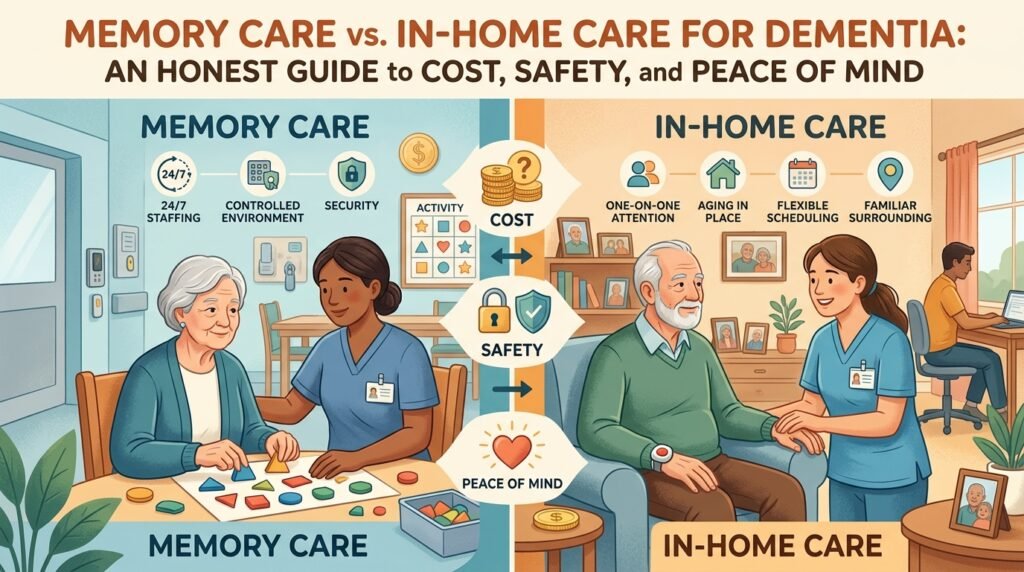
Why This Decision Feels So Impossible — And Why You’re Not Alone
No one wakes up one morning and decides they want to leave the home they’ve lived in for decades. Not the parent who raised their children within those walls. Not the grandparent whose entire life is stored in the closets, the photo albums, and the worn spot on the favorite armchair. And no adult child wants to be the one who “takes that away” from someone they love.
If you’re reading this because you’re wrestling with whether your parent or spouse should stay at home or move into a memory care community, please know this first: the discomfort you feel is not a sign you’re doing something wrong. It’s a sign you’re taking this seriously.
This is one of the most emotionally loaded decisions a family will ever face — and it’s also one of the most consequential financially. More than 7 million Americans age 65 and older are currently living with Alzheimer’s disease, a number expected to keep climbing as the population ages<cite index=”9-1″>More than 7 million Americans have Alzheimer’s. An estimated 7.4 million Americans age 65 and older are living with Alzheimer’s in 2026.</cite>. Nearly 12 million family members and friends are providing unpaid care for a loved one with dementia right now<cite index=”18-1″>Nearly 12 million family members and other unpaid caregivers provided an estimated 19.2 billion hours of care to people with Alzheimer’s or other dementias in 2024.</cite>.
In other words: if this feels overwhelming, that’s because it genuinely is a big deal. And the good news is that you don’t have to figure it out with guesswork. There’s real data — on cost, on safety, and on what actually helps families avoid crisis — that can guide this decision. This guide walks through it all, step by step, so you can make a choice you feel confident about.
Understanding the Real Trajectory of Dementia
It’s tempting to think of “staying safe at home” as a fixed, permanent plan. In reality, dementia is a progressive condition, and what’s safe and sustainable today may not be safe or sustainable in a year — or even a few months.
As the disease advances, common changes include:
- Increased confusion about time, place, and even familiar people
- Wandering — attempting to leave the house, sometimes at night, often without any awareness of danger
- Difficulty with daily tasks like bathing, dressing, or medication management
- Behavioral and personality changes, including agitation or resistance to care
Wandering deserves special attention because it’s one of the most common triggers for a move to a higher level of care. Research indicates that between 35% and 60% of people living with dementia will wander at least once during the course of their illness<cite index=”34-1″>It is estimated that between 35% and 60% of people with dementia will wander at least once.</cite>. This isn’t a rare or extreme scenario — it’s something the majority of families affected by dementia should be prepared to plan around, whether that means home modifications, monitoring technology, or a secured community environment.
The takeaway isn’t that every family needs to move a loved one immediately. It’s that the plan you choose today should be revisited regularly, because the level of care that’s appropriate can change faster than families expect.
The Cost Comparison Almost Everyone Gets Wrong
Here’s a myth that trips up more families than almost anything else in this decision: the assumption that keeping a loved one at home is automatically the cheaper option.
For a few hours of help per week, that’s often true. But once a loved one needs supervision around the clock — which is common in moderate-to-advanced dementia — the math flips dramatically.
What In-Home Care Actually Costs
According to the CareScout (formerly Genworth) Cost of Care Survey, one of the most comprehensive long-term care cost studies in the country, the national median hourly rate for non-medical in-home caregiver services is now in the $33–$34 per hour range<cite index=”25-1″>The national hourly median cost ranges from $33 to $34.</cite>. Based on a typical 44-hour-per-week arrangement, that works out to roughly $80,000 a year<cite index=”19-1″>At that rate, the annual cost totals $80,080, assuming 44 hours of care a week.</cite> — and that’s for part-time, not round-the-clock, coverage.
If your loved one needs 24/7 supervision — which is common once wandering, nighttime confusion, or safety risks are a factor — the math climbs even higher, often exceeding $25,000 per month, or well over $250,000 a year, when multiple caregivers or shifts are required.
What a Memory Care Community Typically Costs
By contrast, memory care communities — which provide 24-hour supervision, secured environments, and staff trained specifically in dementia care — carry a national median cost that is significantly lower than round-the-clock in-home care. Industry data places the national median for assisted living at around $6,200 per month (about $74,400 a year)<cite index=”21-1″>The national median monthly cost for assisted living communities increased 5% to $6,200 per month, or $74,400 annually.</cite>, with memory care typically running 20–30% higher than standard assisted living due to the specialized staffing and secured environment it requires<cite index=”24-1″>Memory Care: We covered this in the memory care section – memory care typically costs an extra 20–30%.</cite>.
The bottom line: For a few hours of help a day, in-home care is often the more affordable choice. But once full-time supervision becomes necessary, a memory care community frequently costs less than the equivalent hours of private in-home care — a reality that catches many families off guard.
| Care Type | Typical Cost |
|---|---|
| In-home care (44 hrs/week) | ~$80,000/year |
| In-home care (24/7 coverage) | $250,000+/year |
| Assisted living (national median) | ~$74,400/year |
| Memory care (national median, est.) | ~$89,000–$97,000/year |
Figures are national medians and will vary significantly by state and provider. Use a cost-of-care calculator for your specific region before making financial decisions.
If Neither Option Feels Affordable
It’s important to say plainly: for many families, even the “lower” option is a real financial stretch. If that’s your situation, you’re not alone, and you have options worth exploring:
- Respite care — short-term, temporary in-home or community-based care that gives family caregivers a break without committing to a permanent move
- Medicaid long-term care benefits, which cover custodial care once other resources are largely exhausted (note: Medicare generally does not cover this type of long-term custodial care)
- Veterans benefits, if your loved one or their spouse served in the military
- Long-term care insurance, if a policy was purchased in advance
- Area Agencies on Aging, which can connect families to local, often lower-cost, community resources
The Safety Conversation Families Often Avoid
Cost is only half the equation. The other half — and arguably the more urgent one — is safety.
Common home-based risk factors that tend to force a reassessment include:
- Multi-level homes with staircases that become fall hazards
- Kitchens, where a stove left on can become a genuine fire risk
- Unsecured exits, which matter enormously given how common wandering is
- Isolation, especially for a spouse who is the sole caregiver and has no backup if they become sick or injured themselves
Memory care communities are specifically designed to reduce these risks: secured entrances and perimeters, staff trained to redirect wandering behavior safely, and 24-hour coverage that doesn’t disappear because one caregiver called in sick or got stuck in a snowstorm. That built-in redundancy is one of the most underappreciated advantages of community care — in a home setting, if your one caregiver can’t make it, there often isn’t a backup.
A Word on Caregiver Continuity
If your family does choose in-home care, consistency matters more than most people realize. Individuals with dementia often rely heavily on familiar faces and routines; a rotating cast of unfamiliar caregivers can actually increase confusion, agitation, and resistance to care — sometimes undermining the very stability that home care was meant to preserve. When evaluating a home care agency, it’s worth asking directly:
- Will the same caregiver (or a small, consistent team) be assigned consistently?
- What specific dementia and memory care training do caregivers receive?
- What is the backup plan if the regular caregiver is unavailable?
The Health Toll on Family Caregivers — Backed by the Data
Perhaps the most important — and most overlooked — piece of this entire decision is what happens to the caregiver.
There is a persistent, almost universal instinct among family caregivers, especially spouses, to believe “no one else could take care of them as well as I can.” It’s a loving instinct. It’s also one that leads many caregivers to delay getting help until they’re in crisis themselves.
The research on this is sobering:
- The CDC estimates that about 60% of dementia caregivers experience high levels of emotional distress, and roughly 40% report symptoms of depression<cite index=”31-1″>The CDC estimates that about 60% of dementia caregivers suffer from high rates of emotional distress and approximately 40% report symptoms of depression.</cite>.
- Nearly 70% of dementia caregivers report high levels of stress, according to the Alzheimer’s Association, placing them at elevated risk for burnout<cite index=”30-1″>According to the Alzheimer’s Association, nearly 70% of dementia caregivers report high levels of stress, putting them at greater risk of burnout.</cite>.
- Studies show dementia caregivers experience higher rates of stress, depression, and anxiety, and lower overall well-being, compared to caregivers of people without dementia<cite index=”31-1″>Dementia caregivers report higher levels of stress, more depression and anxiety symptoms, and lower levels of subjective well-being than non-caregivers, according to an Alzheimer’s caregivers study by researchers at the University College of London.</cite>.
- Disrupted sleep is common and compounding: nighttime wandering and agitation often mean caregivers sleep lightly or wake repeatedly, and chronic sleep loss is itself a major driver of burnout<cite index=”30-1″>Wandering, agitation, or mood changes can happen at night to dementia patients, causing many caregivers to sleep lightly or wake frequently to check on their care recipient. Chronic fatigue and disrupted sleep are common; over time, the lack of rest becomes a major risk factor for caregiver burnout.</cite>.
This isn’t a character flaw or a failure of devotion. It’s a well-documented, physiological response to sustained, high-intensity stress. Caregiver burnout has real consequences — for the caregiver’s own health, and, research shows, it’s linked to earlier placement of loved ones into long-term care and higher rates of hospitalization for caregivers themselves.
If you are a caregiver reading this and recognizing yourself in these numbers, please hear this clearly: prioritizing your own well-being is not selfish. It is what allows you to keep showing up for the person you love.
Practical & Actionable Strategy: What to Do Starting Today
You don’t need to solve this entire decision in one sitting. Here’s a manageable, step-by-step approach:
1. Get an honest safety assessment this week
Walk through the home (or ask a home care agency or occupational therapist to do it with you) and identify specific risks: stairs, stove access, exits, tripping hazards. This turns a vague worry into a concrete list you can act on.
2. Run the real numbers for your situation
Use an online cost-of-care calculator to estimate both in-home care and memory care costs specific to your state and your loved one’s actual care needs — not national averages. Compare the realistic hourly need (is it 4 hours a day, or 24?) against community pricing.
3. Build in respite care immediately — even if you’re not ready for a bigger move
You do not need to decide between “full-time home care” and “moving to a community” today. A few hours of in-home respite care each week, or an occasional short-term community respite stay, can relieve pressure right now while you take time to plan.
4. Schedule your own medical check-up
If you are the primary caregiver, book a check-up for yourself — not just your loved one. Ask your doctor directly about your stress levels and sleep. Catching caregiver burnout early is far easier than recovering from a full collapse.
5. Ask pointed questions before hiring any in-home agency
Specifically ask about dementia-specific training, caregiver consistency, and backup coverage plans. Don’t assume all home care is created equal.
6. Tour at least two memory care communities — even if you’re “not ready”
Touring isn’t a commitment. It gives you a realistic frame of reference for cost, environment, and what “24-hour trained supervision” actually looks like in practice, so that if a safety crisis does happen, you’re not researching from zero.
7. Loop in the whole family and the doctor
Decisions made under sudden crisis (a fall, a wandering incident, a caregiver health scare) are far more stressful than decisions made proactively. If safety concerns are already emerging, bring in your loved one’s physician and other family members now, while there’s still time to plan calmly.
A Warm Closing Note
No one’s life is free from love, sorrow, and difficult choices. These elements are inevitable when caring for someone suffering from a condition like dementia. Whether you decide to bring in extra help at home, arrange for respite care, or move your loved one to a specialized memory care facility, the very fact that you are carefully researching, asking questions, and weighing your options demonstrates that you are doing the right thing for them.
You do not need to resolve everything perfectly right away. Take it one step at a time, and make use of relevant information and the expertise of professionals in the field. Above all, remember to take care of yourself—through proper nutrition, exercise, and hobbies. Your health matters; maintaining your own well-being is not just a separate concern but an essential part of the caregiving journey itself.
Have a great day today, too.
This article is intended for general informational purposes and does not constitute medical, legal, or financial advice. Please consult a physician, elder law attorney, or financial advisor to discuss decisions specific to your family’s situation.
Leave a Reply