Let’s be honest. You’ve been doing the “right” things — contributing to your 401(k), maybe even maxing out your IRA. You check the boxes every year, watch the balance slowly grow, and tell yourself you’re on track for a comfortable retirement.
But here’s the uncomfortable truth: for millions of Americans in the 30–50 age bracket, those accounts alone may fall dangerously short.
Consider this: The 2024 contribution limit for a 401(k) is $23,000 (or $30,500 if you’re 50+). Add in a Roth or Traditional IRA at $7,000, and you’re looking at a maximum of $30,000 per year in tax-advantaged savings. If you retire at 65 and need $80,000–$100,000 per year for 25–30 years, the math gets uncomfortable fast — especially when you factor in inflation, healthcare costs, and the very real possibility that Social Security benefits will be reduced by the time you retire.
The good news? There are smart, tax-efficient strategies that go well beyond the standard 401(k)/IRA playbook. Let’s walk through five of them.
1. The HSA: The Most Underrated Triple-Tax-Advantage Account in America
If you’re enrolled in a High-Deductible Health Plan (HDHP), you may be sitting on one of the most powerful retirement vehicles available — and not even know it.
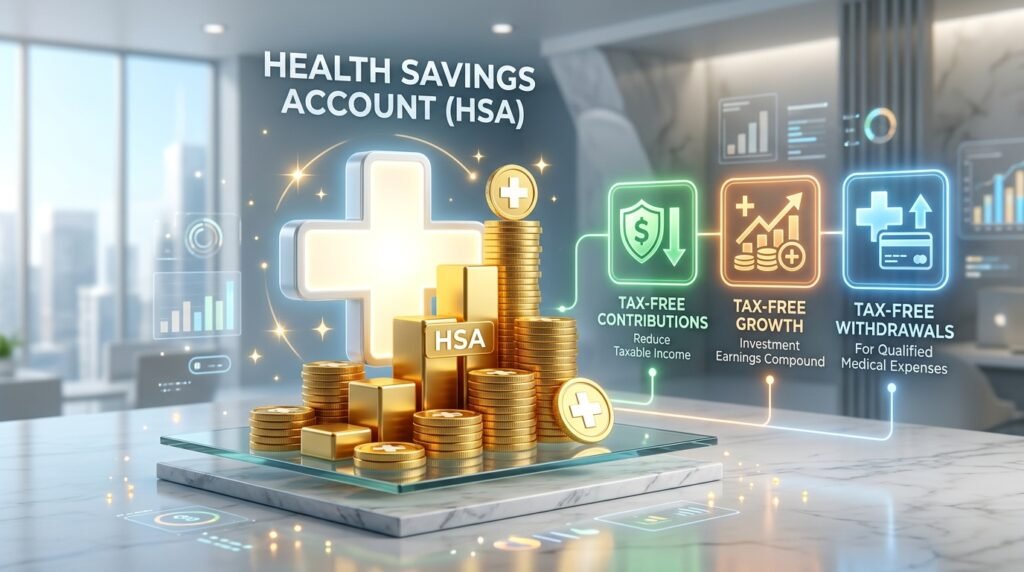
A Health Savings Account (HSA) offers a triple tax benefit that not even a 401(k) or IRA can match:
- Contributions are tax-deductible (or pre-tax if made through payroll)
- Growth is tax-free
- Withdrawals for qualified medical expenses are tax-free
Under IRC Section 223, the 2024 HSA contribution limits are $4,150 for individuals and $8,300 for families (plus a $1,000 catch-up for those 55+).
How to Use HSA as a Retirement Account
Here’s the strategy most people miss: pay your current medical expenses out of pocket, and let your HSA grow invested. Once you turn 65, you can withdraw HSA funds for any purpose — not just medical — and it’s taxed like a traditional IRA distribution. But if you use it for healthcare costs, it’s completely tax-free.
Given that Fidelity estimates the average retired couple will need $315,000 for healthcare costs alone in retirement, this account becomes a laser-targeted retirement weapon.
Pros
- Triple tax advantage — unmatched by any other account
- Funds roll over year to year (no “use it or lose it”)
- Many HSA custodians allow you to invest in mutual funds, ETFs, and index funds
Cons
- Requires enrollment in an HDHP — not ideal for those with frequent medical needs
- Limited annual contribution amount
- Must keep receipts if you plan to reimburse yourself years later (highly recommended strategy)
Action Step: If you’re on an HDHP and not maximizing your HSA, start today. Treat it as your stealth retirement account.
2. Taxable Brokerage Accounts: More Flexibility Than You Think

Once you’ve maxed your tax-advantaged accounts, a taxable brokerage account is your next frontier. Yes, you pay taxes on gains — but with smart strategies, the tax burden is far more manageable than most people assume.
Key Tax Advantages to Know
- Long-term capital gains rates (assets held 12+ months) are 0%, 15%, or 20% — significantly lower than ordinary income tax rates. This is governed by IRC Section 1(h).
- Tax-loss harvesting: You can sell losing positions to offset capital gains, reducing your tax bill (IRC Section 1211–1212).
- Step-up in basis at death: Heirs inherit assets at current market value, potentially eliminating embedded capital gains entirely (IRC Section 1014).
- Qualified dividends are taxed at preferential rates (0–20%) under IRC Section 1(h)(11).
Smart Investment Choices for Taxable Accounts
- Index funds and ETFs — low turnover = fewer taxable events
- Municipal bonds — interest is federal tax-exempt (and often state tax-exempt too)
- Growth stocks — defer gains by not selling until you need income
Pros
- No contribution limits
- No required minimum distributions (RMDs)
- Full flexibility — access funds anytime without penalties
Cons
- Dividends and realized gains are taxable annually
- Requires disciplined, tax-aware investing
Pro Tip: Hold tax-inefficient assets (bonds, REITs, actively managed funds) in your tax-advantaged accounts, and keep tax-efficient assets (index ETFs, growth stocks) in your taxable account. This “asset location” strategy can meaningfully increase your after-tax returns over decades.
3. Real Estate: Build Wealth Through Cash Flow and Appreciation

Real estate remains one of the most reliable wealth-building tools in American history — and for good reason. It combines recurring cash flow, appreciation, leverage, and powerful tax advantages that paper assets simply can’t match.
The Tax Code Is Unusually Generous to Real Estate Investors
- Depreciation deduction (IRC Section 168): Residential rental property is depreciated over 27.5 years. Even if the property is appreciating in market value, you can deduct depreciation against rental income — a phantom expense that shelters real cash flow.
- 1031 Exchange (IRC Section 1031): Sell one investment property and roll gains into a new one — tax deferred indefinitely.
- Passive activity loss rules (IRC Section 469): Real estate professionals or those who actively participate may be able to deduct rental losses against ordinary income.
- Opportunity Zone investments (IRC Section 1400Z-2): Defer and potentially reduce capital gains by reinvesting into designated distressed communities.
Entry Points That Don’t Require a Down Payment on a Rental Property
- REITs (Real Estate Investment Trusts): Invest in real estate portfolios like a stock, through your brokerage account
- Real estate crowdfunding (e.g., Fundrise, CrowdStreet): Start with as little as $500–$1,000
- House hacking: Buy a multi-unit property, live in one unit, rent the others
Pros
- Rental income can replace a paycheck in retirement
- Multiple layers of tax advantages
- Hedge against inflation — rents and property values tend to rise over time
- Leverage amplifies returns (using a mortgage to control a $400k asset with $80k down)
Cons
- Requires significant capital and/or credit for direct ownership
- Landlord responsibilities can be time-intensive
- Illiquid — not easy to sell quickly if you need cash
- Market and tenant risks are real
The Long View: Even one rental property purchased in your 30s or 40s, paid off by retirement, can generate $1,500–$3,000/month in tax-advantaged income — a meaningful supplement to your other retirement income.
4. Annuities and Whole Life Insurance: Guaranteed Income and Tax-Deferred Growth

These two products are among the most misunderstood — and sometimes unfairly maligned — tools in retirement planning. Used correctly and in the right situations, they can provide something your stock portfolio cannot: guaranteed lifetime income and protection against sequence-of-returns risk.
Annuities
An annuity is a contract with an insurance company. You pay a lump sum or series of payments, and in return, the insurer provides guaranteed income — either immediately or at a future date.
- Fixed Annuities: Predictable, guaranteed interest rate — like a CD but often with better rates
- Variable Annuities: Returns tied to sub-accounts (like mutual funds) — more growth potential, more risk
- Fixed Indexed Annuities (FIAs): Returns linked to a market index (e.g., S&P 500) with downside protection
From a tax standpoint, non-qualified annuity earnings grow tax-deferred under IRC Section 72. You only pay ordinary income tax on the earnings when you withdraw — and you can contribute with no annual limit (unlike IRAs).
Whole Life Insurance as a Retirement Tool
Permanent life insurance with a cash value component (Whole Life or Indexed Universal Life) allows for:
- Tax-deferred cash value accumulation
- Tax-free loans and withdrawals from the policy (up to basis)
- Tax-free death benefit under IRC Section 101(a)
- Potential use in a Paid-Up Additions (PUA) strategy to turbo-charge cash value growth
High-income earners who are phased out of Roth IRA contributions sometimes use this strategy as a “bank on yourself” approach or as an alternative to taxable accounts.
Pros
- Guaranteed income you cannot outlive (annuities)
- Tax-deferred and potentially tax-free growth
- No contribution limits on non-qualified annuities
- Creditor protection in many states
Cons
- Fees can be high — especially on variable annuities and whole life policies
- Less liquidity, especially in early years (surrender charges)
- Complexity — you need to understand what you’re buying
- Not ideal as a first savings vehicle — max out 401(k)/IRA/HSA first
Important: These products are not appropriate for everyone. Work with a fee-only fiduciary advisor to determine if they fit your specific tax situation, income level, and retirement goals.
5. Side Hustles: The Underestimated Retirement Accelerator

Here’s the strategy that doesn’t get nearly enough credit in traditional financial planning discussions: earning more money.
It sounds almost too simple, but a side hustle does something your investment accounts cannot: it generates new capital that you can deploy into every strategy above. More importantly, if that side hustle is structured correctly, it unlocks additional tax-advantaged retirement accounts.
Self-Employment Opens New Tax-Advantaged Doors
If you have self-employment income — from freelancing, consulting, a small business, or the gig economy — you can contribute to:
- SEP-IRA: Contribute up to 25% of net self-employment income, with a 2024 maximum of $69,000 (IRC Section 408(k))
- Solo 401(k): If you have no full-time employees, contribute up to $69,000 in 2024 — including both employee and employer contributions — with a Roth option available (IRC Section 401(a))
- SIMPLE IRA: If your side business grows enough to have a few employees
A self-employed person contributing the maximum to a Solo 401(k) in addition to their employer-sponsored 401(k) could potentially shelter well over $90,000 per year from taxes — a powerful wealth acceleration strategy.
Side Hustle Ideas Worth Considering
- Freelance consulting in your professional field
- Online courses or coaching
- Real estate investing (which connects back to Strategy #3)
- Content creation (YouTube, Substack, podcasting)
- E-commerce or dropshipping
- Part-time professional services (accounting, design, legal, medical)
Pros
- Generates new capital for investing
- Unlocks additional tax-advantaged retirement account space
- Business deductions reduce taxable income (home office, equipment, travel — IRC Section 162)
- Can evolve into a full retirement income stream
Cons
- Takes time and energy — burnout is real
- Self-employment taxes (15.3% on net earnings) must be accounted for
- Requires discipline to redirect income into investments rather than lifestyle inflation
The Rule: Every dollar earned from a side hustle that goes directly into a Solo 401(k) or SEP-IRA works twice — it reduces your taxable income and builds retirement wealth. That’s the compounding multiplier most people overlook.
Putting It All Together: Your Retirement Layering Strategy
The most financially resilient retirees don’t rely on a single account or strategy. They build multiple income streams — each with different tax treatments, risk profiles, and timing — so that no single failure can derail their retirement.
Think of it as a layered system:
- Layer 1 — Foundation: 401(k) and IRA (maximize first)
- Layer 2 — Health Shield: HSA (for tax-free healthcare and retirement savings)
- Layer 3 — Market Growth: Taxable brokerage with tax-smart investing
- Layer 4 — Tangible Assets: Real estate for cash flow and appreciation
- Layer 5 — Income Guarantee: Annuity or cash value life insurance (for the right profile)
- Layer 6 — Fuel: Side hustle income to accelerate all of the above
The earlier you start building these layers — even one or two at a time — the more powerful compound growth becomes. Time in the market, combined with strategic tax management, is what separates a stressed retirement from a confident one.
A final note on taxes: The tax code is not static. Contribution limits adjust annually, capital gains rates can change with legislation, and strategies that work today may need to adapt tomorrow. That’s why working with a fee-only, fiduciary financial advisor and a CPA who understands retirement planning is not a luxury — it’s a competitive advantage.
Many people fail to get started even after reading about these strategies, often due to perfectionism or perhaps a lack of funds. However, try following these steps gradually and let go of the pressure to set up every account all at once. For instance, simply start by setting up an automatic transfer for your HSA or researching Solo 401(k) plans. Retirement planning is a marathon, and your greatest enemy isn’t the rate of return—it’s the time spent not getting started.
When accounting for inflation, the commonly cited goal of a “$1 million retirement fund” may be worth only about $500,000 to $600,000 in today’s terms twenty years from now. This is why the focus should be on generating cash flow rather than simply accumulating cash. Allocating capital to assets that appreciate over time—such as stocks, real estate, and businesses—is not merely a choice but a survival strategy.
Retirement Readiness Self-Assessment Checklist
Take five minutes to honestly answer these questions. They’ll tell you more about your retirement readiness than any calculator.
- ☐ Am I maximizing my 401(k) contribution (especially the employer match)?
- ☐ Am I contributing to an IRA (Roth or Traditional) based on my income level?
- ☐ If I’m on an HDHP, am I maximizing my HSA — and investing those funds?
- ☐ Do I have a taxable brokerage account, and am I using tax-efficient investment strategies (asset location, loss harvesting)?
- ☐ Do I own — or have a plan to own — any income-generating real estate?
- ☐ Have I explored whether an annuity or permanent life insurance fits my income and tax situation?
- ☐ Do I have any self-employment income that could qualify me for a SEP-IRA or Solo 401(k)?
- ☐ Have I projected what my total annual income will look like in retirement — from all sources?
- ☐ Have I reviewed my strategy with a fee-only fiduciary advisor in the last two years?
- ☐ Am I protecting my wealth from lifestyle inflation as my income grows?
If you checked fewer than 6 of these boxes, it may be time to schedule a comprehensive financial review. Retirement success is built one intentional decision at a time — and the best decision you can make today is to start broadening your strategy beyond the basics.
Disclaimer: This article is for educational purposes only and does not constitute personalized financial, tax, or legal advice. Tax laws and contribution limits are subject to change. Please consult a qualified financial advisor and CPA before making decisions about your retirement strategy.
Leave a Reply