Over 60? 5 Silent Vegetable “Killers” of Your Kidneys
(And 4 Delicious Ones to Eat Instead)
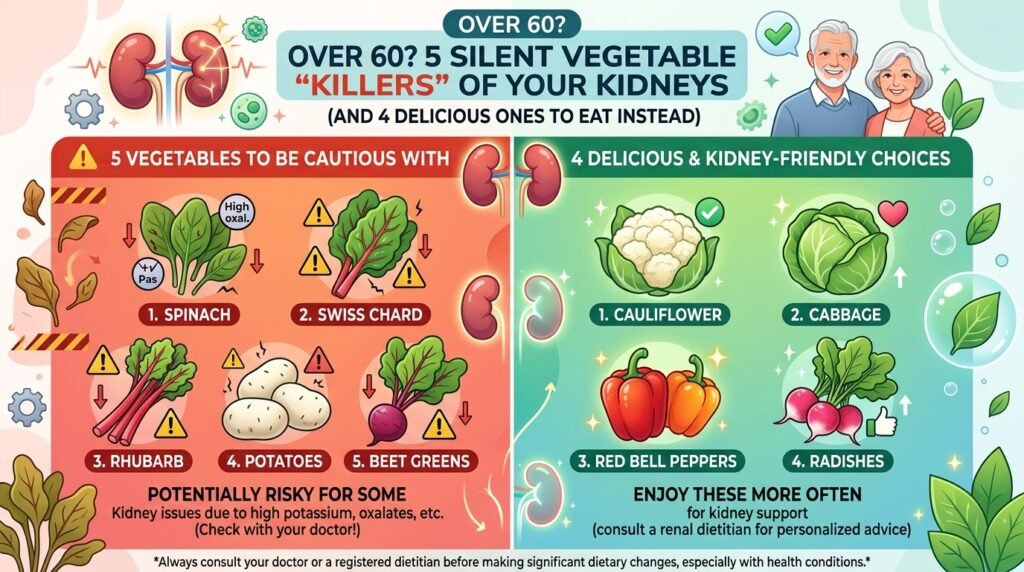
What your doctor wishes you knew about the “healthy” vegetables that can quietly burden aging kidneys — and the science-backed swaps that protect them.
Medically Reviewed Content | 10–12 min read | Updated June 2026
Key Takeaways — Read This First
- Your kidneys change after 60. Kidney function naturally declines with age, making mineral management more critical than ever.
- Some “healthy” vegetables can be problematic for aging kidneys — not because they are bad foods, but because their high potassium or oxalate content can overwhelm kidneys already working harder to keep up.
- The 5 vegetables to be mindful of: Spinach, Potatoes & Sweet Potatoes, Beet Juice, Concentrated Tomato Products, and Swiss Chard.
- The 4 delicious alternatives: Cauliflower, Red Bell Peppers, Garlic, and Cabbage — all low in potassium and oxalates, and full of protective nutrients.
- No drastic changes without guidance. Always consult a nephrologist or renal dietitian before significantly altering your diet. Individual lab values matter enormously.
Why Kidney Health Becomes Your Silent Priority After 60
You have eaten your spinach. You have roasted your sweet potatoes. You have added beet juice to your morning smoothie. For decades, these choices felt like the definition of taking care of yourself. And for much of your life, they were exactly right.
But here is something your body may have quietly been trying to tell you: after 60, your kidneys are working under entirely different conditions.
According to the National Kidney Foundation, kidney function naturally declines with age. By the time most people reach their late 60s, their kidneys may be filtering blood at only 60–75% of the efficiency they had at 30. This age-related decline is so gradual — and so symptomless in its early stages — that the American Kidney Fund estimates 9 out of 10 people with early chronic kidney disease (CKD) don’t even know they have it.
The warning signs that do appear are easy to dismiss: a little more fatigue than usual, mild puffiness around the ankles in the evening, the occasional sensation of being foggy. Many people chalk these up to “normal aging.” Sometimes they are. But sometimes they are the kidneys’ first, quiet whispers asking for help.
This is where nutrition enters the picture — and where the story gets genuinely surprising for many seniors. The same vegetables celebrated in mainstream health media as superfoods can, in some circumstances, place a real and measurable burden on kidneys that are already working overtime. This article explains exactly why, names the specific vegetables to approach with more caution after 60, and then — crucially — gives you a satisfying, flavorful roadmap of what to eat instead.
⚠️ Important Note: The information in this article is for educational purposes only. Kidney dietary needs are highly individual and depend on your specific stage of kidney disease, current lab values (especially potassium, phosphorus, and creatinine), and other health conditions. Please work with your nephrologist and a registered renal dietitian before making significant dietary changes.
The 5 Vegetables to Watch and Limit After 60
To be clear: none of the vegetables below are “bad” in an absolute sense. For people with healthy, fully functioning kidneys, most of them are nutritional powerhouses. The issue is one of context and capacity. When kidney filtration slows, two specific compounds — potassium and oxalates — can accumulate in ways that create real health risks. The vegetables below happen to be particularly concentrated sources of one or both.
⚠️ Vegetable to Watch #1
🥬 Spinach — The Double Burden of Oxalates & Potassium
Very High OxalatesHigh Potassium (~558mg/cup cooked)Kidney Stone Risk
Spinach is one of the most celebrated vegetables in nutritional culture — and with good reason, for most people. But for those over 60 managing kidney health, it earns a unique distinction: it is simultaneously one of the highest-oxalate and highest-potassium vegetables you can eat.
The Science
A normal portion of spinach (50–100 g) delivers approximately 500–1,000 mg of dietary oxalate and can significantly increase urinary oxalate excretion, according to a widely cited review published in Frontiers in Nutrition (PMC6459305). A prospective study published in PMC Nutritional Epidemiology (PMC9632065) found that higher dietary oxalate intake was positively associated with incident CKD (Hazard Ratio 2.59) and lower eGFR values over time — meaning kidneys filtered less efficiently as oxalate consumption increased. One cup of cooked spinach also contains approximately 558 mg of potassium — nearly 28% of the daily allowance for someone in CKD stages 4–5.
When oxalates are not properly filtered (as is more likely in aging or compromised kidneys), they can bind with calcium to form calcium oxalate crystals — the most common type of kidney stone. For those who have already had a calcium oxalate stone, nephrologists often specifically recommend eliminating, not merely limiting, spinach.Practical Tip:
- If you are in early-stage CKD (stages 1–2) and not hyperkalemic, small amounts may be acceptable — but confirm with your dietitian.
- Boiling spinach and discarding the water can reduce oxalate content by 30–80%, but spinach starts so high that even reduced levels remain significant.
- Consider switching to arugula or kale, which are far lower in oxalates while still offering iron and vitamins.
⚠️ Vegetable to Watch #2
Potatoes & Sweet Potatoes — The Potassium Powerhouses
Very High Potassium (700–900mg per medium serving)Hyperkalemia RiskHeart Rhythm Concern
Potatoes — in all their comforting forms — are one of the most consumed vegetables in the world. They are also among the most potassium-dense, which makes them a specific area of concern for seniors with declining kidney function.
The Science
A 2024 clinical study published in Kidney International Reports (PubMed ID: 38621432), involving 285 CKD patients across hospitals in Tokyo, found a direct association between potassium intake specifically from potatoes and hyperkalemia (serum potassium ≥5.0 mEq/L). Importantly, this association held even when total potassium intake from other sources did not predict hyperkalemia — suggesting something specific about the bioavailability of potassium from potatoes. Hyperkalemia is not merely a laboratory number. According to a review in Clinical and Experimental Nephrology, elevated potassium can cause dangerous cardiac rhythm changes and is associated with increased all-cause mortality in CKD patients.
A medium baked potato contains around 900 mg of potassium. A medium sweet potato comes in at approximately 540 mg. Both figures can represent an enormous portion of the daily 2,000 mg limit recommended for those in CKD stages 4–5.The Leaching Method — A Practical Reduction Strategy:
- Peel and cut the potato into thin, small pieces (1-inch cubes or thinner slices).
- Soak in a large bowl of warm water for a minimum of 2 hours (or overnight in cold water in the refrigerator).
- Drain the water completely, rinse the pieces well, then boil in fresh water using a large water-to-potato ratio.
- Drain again before eating. This process can remove up to 50% of the potassium content.
- Note: Avoid skin-on preparations or baking, as these concentrate and retain more potassium.
Even with leaching, portion control remains essential. Check your own lab values with your care team before deciding how much — if any — potato to include.
⚠️ Vegetable to Watch #3
Beet Juice — When “Healthy” Gets Too Concentrated
Concentrated OxalatesHigh PotassiumJuicing Multiplies Risk
Beets have earned a legitimate reputation for supporting blood pressure through their natural nitrate content. But there is a critical distinction that the health food industry rarely makes clearly: whole beets and beet juice are not the same thing from a kidney risk perspective.
The Science
Research on dietary oxalates and kidney inflammation, published in PMC Nutrients (PMC11193404), includes beets among the high-oxalate foods that may contribute 40–50% of urinary oxalate in individuals with compromised kidney function. Crucially, a review examining juiced vegetables (PMC6459305) notes that “juiced” vegetables represent a particular concern because the concentration effect dramatically increases oxalate load per volume consumed. When you juice beets, you remove the fiber that slows oxalate absorption, and you condense the oxalate and potassium content of multiple beets into a single glass. A 2026 clinical commentary noted that people with pre-existing CKD have impaired oxalate excretion, “dramatically increasing the risk of calcium oxalate crystal deposition in kidney tubules” — making concentrated beet preparations especially problematic for this population.
Think of it this way: drinking a cup of beet juice is roughly equivalent — in oxalate and potassium terms — to eating several whole beets in rapid succession, without any of the fiber that would slow absorption and signal satiety.Practical Advice:
- If you enjoy beets, prioritize whole, boiled beets in small portions over juice. Boiling is the most effective preparation method to reduce oxalate content, as it leaches into the cooking water.
- If you love the flavor of beet juice, diluting a small amount (2–3 tablespoons) with water or pairing it with a calcium-rich food can help bind oxalates in the gut before they reach the kidneys.
- If you have a history of kidney stones or are in CKD stage 3 or higher, discuss beet products specifically with your nephrologist before consuming them regularly.
⚠️ Vegetable to Watch #4
🍅 Concentrated Tomato Products — A Hidden Potassium Trap
Very High Potassium When ConcentratedHigh Sodium (Canned)Processing Changes Everything
A single medium fresh tomato contains a moderate 290 mg of potassium — perfectly manageable for most seniors, even those in early CKD. The danger is not the tomato; it is the form the tomato takes when it passes through modern food processing.
The Science — The Numbers Tell the Story
When tomatoes are cooked down into concentrated forms, their water content evaporates but their potassium stays. A cup of tomato sauce contains approximately 728 mg of potassium — the equivalent of 2.5 medium fresh tomatoes. Tomato paste reaches approximately 670 mg per quarter cup. Sun-dried tomatoes top out at around 925 mg per half cup. Kidney Care UK’s clinical nutritional guidelines specifically advise CKD patients who need to lower potassium to avoid tomato juice and use tomato purée only in very small amounts. For context, a typical pasta dinner with one cup of tomato sauce delivers more potassium from the sauce alone than an entire banana — a food most kidney patients already know to limit.
Canned tomato products compound the issue with a second problem: added sodium. Canned tomatoes can contain 100–300 mg of sodium per serving — a serious concern for seniors managing blood pressure alongside kidney health. High sodium intake causes the body to retain fluid, raises blood pressure, and increases the kidneys’ filtration workload.Smart Swaps at the Stove:
- Use one or two fresh, diced tomatoes in recipes instead of canned tomato sauce or paste.
- When a recipe calls for tomato paste for depth of flavor, use just a teaspoon, then bulk up the sauce base with roasted red bell peppers or zucchini — both kidney-friendly and delicious.
- Always choose “no added salt” canned tomato products and drain the liquid before using.
- At restaurants, request pasta with olive oil and garlic rather than marinara, or ask for sauce “on the side” to control the amount used.
⚠️ Vegetable to Watch #5
🌿 Swiss Chard — The Double Burden Leafy Green
High Potassium (~960mg/cup cooked)Very High OxalatesDouble Risk
Swiss chard is genuinely beautiful — its colorful stalks and rich, earthy leaves make it a favorite in health-conscious kitchens. It is also, for seniors managing kidney health, one of the most important greens to monitor carefully, because it carries both of the major kidney concerns simultaneously: very high potassium and very high oxalates.
One cup of cooked Swiss chard delivers approximately 960 mg of potassium — nearly half the daily limit for someone in advanced CKD. It sits alongside spinach and beet greens as one of the leafy vegetables highest in oxalates, making it a genuine “double burden” for kidneys already under strain. Research published in NCBI on the relationship between dietary oxalate, hypertension, and CKD found that participants with higher oxalate intakes had measurably lower eGFR values (kidney filtration rates) over time — and Swiss chard is classified among the highest-oxalate foods in peer-reviewed food composition tables.
For seniors who are otherwise healthy with well-functioning kidneys and normal potassium levels, small amounts of Swiss chard are unlikely to be harmful. But for anyone navigating CKD stages 3–5 or monitoring elevated potassium, it warrants the same caution as spinach.Practical Tip:
- Substitute with green cabbage, kale, or arugula for that leafy-green satisfaction with significantly lower potassium and oxalate loads.
- If you love Swiss chard’s flavor, small amounts boiled and drained (discarding the water) can reduce both potassium and oxalate content modestly.
At a Glance: Vegetables to Limit vs. Vegetables to Enjoy
The table below offers a practical quick-reference comparing the key nutritional profiles of the vegetables discussed in this article. All potassium values are approximate and based on cooked/prepared servings; individual lab results should always guide specific decisions.
| Vegetable | Approx. Potassium | Oxalate Level | Sodium Concern | Status |
|---|---|---|---|---|
| Spinach (1 cup cooked) | ~558 mg | Very High (~750 mg) | Moderate | Limit |
| Potato (1 medium baked) | ~900 mg | Very Low | Low (plain) | Limit / Leach |
| Sweet Potato (1 medium) | ~540 mg | Low-Moderate | Low | Limit |
| Beet Juice (1 cup) | ~440–650 mg | High (concentrated) | Low | Limit / Avoid |
| Tomato Sauce (1 cup) | ~728 mg | Low | Very High (canned) | Limit |
| Swiss Chard (1 cup cooked) | ~960 mg | Very High | Low-Moderate | Limit |
| Cauliflower (1 cup cooked) | ~176 mg | Very Low | Very Low | ✓ Enjoy Freely |
| Red Bell Pepper (1 cup raw) | ~314 mg | Very Low | Very Low | ✓ Enjoy |
| Garlic (2–3 cloves) | ~36 mg | Very Low | Very Low | ✓ Enjoy Freely |
| Cabbage (1 cup cooked) | ~147 mg | Very Low | Very Low | ✓ Enjoy Freely |
Note: Values are approximate; always verify with a registered renal dietitian based on your personal lab results and CKD stage.
4 Kidney-Friendly Vegetables Your Kidneys Will Actually Thank You For
Here is the good news — and there genuinely is good news. You do not have to trade comfort, flavor, or satisfaction to eat in a way that supports your kidneys. These four vegetables are not just “safe” choices; they are actively nutritious, delicious, and deeply versatile.
Kidney-Friendly Choice #1
🥦 Cauliflower — The Ultimate Low-Potassium Comfort Food
Only ~176mg Potassium/CupLow OxalatesHigh in Vitamin CVersatile
If there is one vegetable that renal dietitians recommend above all others, it is cauliflower. At just 176 mg of potassium per cooked cup, it is safe for all stages of CKD. It is low in phosphorus (approximately 40 mg per cup), virtually sodium-free, and delivers around 55 mg of Vitamin C per serving — meeting over 60% of the daily requirement without the potassium penalty that comes with citrus or tomatoes.
But cauliflower’s greatest gift to seniors limiting potatoes and sweet potatoes is its incredible versatility. It can be steamed and mashed into a creamy, buttery texture nearly indistinguishable from mashed potato. It roasts beautifully with garlic and herbs. It can be riced, used as a pizza crust base, or puréed into a silky soup. When you discover cauliflower as a potato replacement, the sacrifice feels less like a restriction and more like a discovery.Try This:
- Steam cauliflower florets until very tender, then blend with a small amount of unsalted butter, white pepper, and garlic — a mashed potato substitute that genuinely satisfies.
- Roast cauliflower florets at 425°F with olive oil, garlic powder, and turmeric for a golden, caramelized side dish.
Kidney-Friendly Choice #2
🫑 Red Bell Peppers — Antioxidant Power in a Low-Potassium Package
~314mg Potassium/Cup (Moderate-Low)Very Low OxalatesRich in Vitamins A, C & B6Anti-Inflammatory
Red bell peppers are a standout in the renal diet — they add bold color, natural sweetness, and a satisfying crunch while keeping potassium remarkably low relative to their nutritional punch. They are an excellent source of Vitamins A, C, and B6, as well as folic acid and fiber, all without the potassium and phosphorus load that makes so many colorful vegetables problematic in kidney disease.
The National Kidney Foundation and numerous renal nutrition guidelines specifically list red bell peppers among the top recommended vegetables for CKD patients. Their natural sweetness also makes them a superb flavor replacement for high-sodium seasonings — roasted red peppers, in particular, create sauces with remarkable depth that can stand in for tomato-based preparations.Try This:
- Roast red bell peppers under the broiler until charred, then blend into a smooth sauce with olive oil and garlic — a kidney-friendly pasta sauce alternative to tomato.
- Stuff with a mixture of cauliflower rice, herbs, and lean protein for a satisfying one-dish meal.
- Eat raw with hummus as a snack — naturally sweet, hydrating, and wonderfully crunchy.
Kidney-Friendly Choice #3
🧄 Garlic — Nature’s Most Powerful Salt Replacement
Only ~36mg Potassium per 2–3 ClovesNegligible OxalatesSupports Blood PressureAnti-Inflammatory Allicin
Garlic holds a special position in the kidney-friendly kitchen: it is one of the most powerful flavor-building ingredients in cooking, yet it contributes negligible amounts of potassium, phosphorus, or oxalates. Two to three cloves contain only approximately 36 mg of potassium — a rounding error in the context of a day’s eating.
Beyond its minimal kidney burden, garlic brings genuine benefits. Its active compound, allicin, has been studied for anti-inflammatory and cardiovascular protective properties. For seniors who need to reduce sodium — one of the most important dietary interventions in CKD for blood pressure control — garlic is arguably the single best natural flavor amplifier available. Roasting garlic mellows its bite into something sweet and complex; fresh garlic adds vibrancy; garlic powder seasons without any sodium.Try This:
- Roast an entire head of garlic at 375°F for 45 minutes, then squeeze the softened cloves onto cauliflower mash, bread, or vegetables — a rich, sweet-savory condiment with virtually no kidney burden.
- Use garlic powder (not garlic salt) liberally as a sodium-free seasoning on everything from roasted cauliflower to grilled chicken.
Kidney-Friendly Choice #4
🥬 Cabbage — The Underestimated Kidney Superfood
Only ~147mg Potassium/Cup CookedVery Low OxalatesCruciferous AntioxidantsAffordable & Versatile
Cabbage is perhaps the most underrated vegetable in senior nutrition. Affordable, widely available year-round, and extraordinarily versatile, it offers a genuinely impressive nutritional profile for kidney patients. At roughly 147 mg of potassium per cooked cup, it is one of the lowest-potassium vegetables you can eat, and its oxalate content is negligible.
As a cruciferous vegetable, cabbage is rich in phytochemicals and antioxidants — including glucosinolates and Vitamin K — that help the body manage oxidative stress, a key factor in CKD progression. It also provides fiber to support gut health, which in turn helps the body manage waste products that declining kidneys struggle to clear. Green cabbage, red cabbage, savoy, and bok choy all carry similar benefits, making it easy to rotate for variety.Try This:
- Sauté shredded green cabbage in olive oil with garlic and a pinch of caraway seeds for a deeply satisfying, German-inspired side dish.
- Use large cabbage leaves as wraps instead of bread or tortillas for a low-potassium, low-phosphorus meal base.
- Add shredded red cabbage raw to salads for crunch, color, and a mild peppery note — no cooking required.
- Make a simple coleslaw with white wine vinegar, a touch of olive oil, and herbs — no mayonnaise needed, and minimal sodium required.
Your Kidneys Are Whispering — It Is Time to Listen
The most important thing to take away from this article is not a list of foods to fear. It is a shift in perspective. Eating for your kidneys after 60 is not about restriction — it is about recalibration. It is about understanding that the same body that thrived on spinach salads and sweet potato fries at 40 now has different needs, different capacities, and different quiet messages it is trying to send you.
The vegetables to be mindful of — spinach, potatoes, beet juice, concentrated tomato products, and Swiss chard — are not villains. They simply carry nutrients that aging kidneys can struggle to process efficiently. And the alternatives — cauliflower, red bell peppers, garlic, and cabbage — are not consolation prizes. They are genuinely wonderful foods full of flavor, color, and nourishment.
Before making any significant dietary changes, please take this information to your nephrologist, your primary care physician, or — ideally — a registered renal dietitian. Your specific lab values (potassium, phosphorus, eGFR, creatinine) should always guide individual decisions. What is right for someone in CKD stage 2 may be very different from what is appropriate for someone in stage 4.
“Your body speaks in whispers long before it speaks in shouts.
Learning to hear those whispers — and respond with intention — is one of the most loving things you can do for yourself.”
Keeping a record will put your mind at ease and facilitate productive conversations with your doctor:
The best way to understand how the food you eat affects your body is to take a little time to keep a simple food diary. Briefly note down what you ate and whether you experienced any changes in fatigue or bloating afterward. The data you gather will serve as invaluable information when consulting with a nephrologist or a dietitian later on. During these consultations, you can ask specific questions about how your body reacts to certain foods; this helps in designing a more accurate, personalized diet plan and plays a crucial role in safeguarding your health.
In closing:
This article conveys a positive message: you have the power to manage your own health, and even small changes can dramatically reduce the burden on your kidneys. Incorporating these insights will help you view dietary management not as a chore, but as an enjoyable process of caring for yourself. Health comes first!
Medical Disclaimer: This article is intended for general educational and informational purposes only and does not constitute medical advice, diagnosis, or treatment. The content draws on published nutritional research and clinical guidelines but should not replace individualized guidance from a qualified healthcare professional. If you have been diagnosed with chronic kidney disease or are experiencing symptoms of kidney dysfunction, please consult your nephrologist, primary care physician, or a registered renal dietitian before making dietary changes. Individual nutritional needs in CKD vary significantly by disease stage and personal lab values. Sources referenced include research indexed in PubMed/NCBI (PMC6459305, PMC9632065, PMC10298248, PubMed ID 38621432, PMC11193404), the National Kidney Foundation dietary guidelines, and clinical kidney nutrition guidance from Kidney Care UK.
Leave a Reply