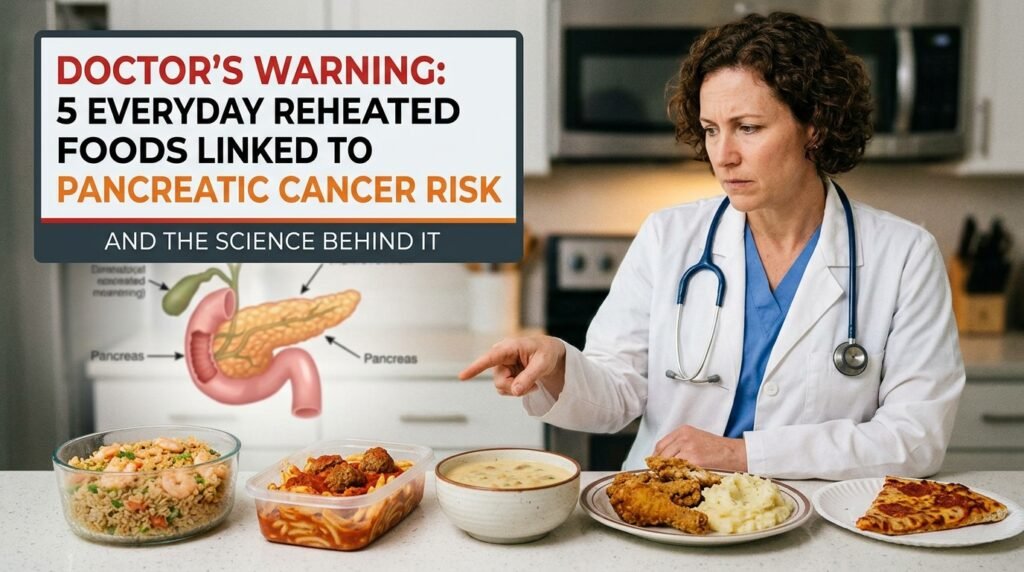
Meta description suggestion: A doctor’s warning about reheated foods is going viral. We cross-checked the claims against IARC, WHO, and peer-reviewed research to separate real risk from kitchen myth — plus the simple fixes that protect your pancreas.
Why This Warning Deserves Your Full Attention
Here is a number that should stop every home cook in their tracks: the five-year survival rate for pancreatic cancer sits at just 12–13%, even in 2025 data from the American Cancer Society. For patients diagnosed with the most common form of the disease, pancreatic adenocarcinoma, that number drops to roughly 8%. Unlike breast or colon cancer, pancreatic cancer rarely announces itself early. By the time symptoms appear, the disease has often already spread.
This is precisely why prevention matters so much more for the pancreas than for almost any other organ. A recent video by Dr. Michael Kent, “Doctor Warns: These 5 Reheated Foods Increase the Risk of Pancreatic Cancer,” has resonated with millions of home cooks — especially older adults who grew up with a “waste not, want not” mindset around leftovers.
But a video is not a medical journal. So we did what any responsible health publication should do: we went back to the primary science — the International Agency for Research on Cancer (IARC), the World Health Organization (WHO), and peer-reviewed studies indexed on PubMed — to verify, expand, and correct the claims where necessary. What follows is not fear-mongering. It is an evidence-based breakdown of five reheating habits that quietly stress your pancreas, your DNA, and your gut — and exactly how to fix each one tonight.
Quick disclaimer: No single food or leftover meal “causes” pancreatic cancer on its own. Cancer develops from cumulative, repeated exposure over years, combined with genetics, smoking, obesity, and chronic inflammation. Think of this article as risk-reduction, not panic.
1. Fried Foods & Reheated Cooking Oils
The Chemical Transformation
Vegetable oils like sunflower, corn, and soybean oil are prized for cooking because they’re light and neutral-tasting — but that’s also their weakness. These oils are high in polyunsaturated fatty acids (PUFAs), which are chemically unstable. Every time you reheat oil — especially oil that’s already been used for frying once — you expose it to a second (or third) round of high heat and oxygen. This triggers a process called lipid peroxidation.
The Pancreas Connection
Lipid peroxidation generates a family of toxic byproducts known as aldehydes, including 4-hydroxynonenal (4-HNE) and malondialdehyde (MDA). These aren’t trace contaminants — repeatedly heated oils can accumulate them at levels high enough to matter biologically. Once ingested, these reactive aldehydes bind to proteins and DNA, forming what scientists call DNA adducts. Over time, this DNA corruption can impair the body’s ability to repair damaged cells correctly, while simultaneously generating free radicals that fuel chronic oxidative stress. The pancreas, which is rich in fat-digesting enzymes and constantly exposed to dietary lipids, is considered particularly vulnerable to this kind of oxidative and inflammatory burden — a pattern researchers have connected to chronic pancreatitis, a well-established risk factor for pancreatic cancer.
Scientific Context
- Multiple food-chemistry studies on repeatedly heated vegetable oils confirm a sharp rise in aldehyde concentration with each reheating cycle, particularly in oils reused for deep frying.
- 4-HNE is one of the most extensively studied lipid peroxidation products in cancer biology, with research linking chronic exposure to genotoxic (DNA-damaging) effects in multiple organ systems.
- The WHO and major nutrition bodies have long flagged repeated deep-frying and oil reuse as a food-safety and chronic-disease concern, independent of this specific video.
The Safe Practical Fix
- Never reuse frying oil more than once — and never reuse oil that has visibly darkened, smells rancid, or has started foaming.
- When reheating fried foods, use an air fryer or oven instead of a fresh pan of oil — this crisps the exterior without adding another oxidation cycle.
- Choose more heat-stable fats for cooking (like avocado oil or olive oil) rather than delicate PUFA-rich oils, especially for high-heat methods.
- Store used cooking oil in a sealed, opaque container away from light and heat if you must reuse it once — light and heat both accelerate oxidation.
2. Leafy Greens (Spinach, Kale, and Chard)
The Chemical Transformation
Leafy greens are naturally high in nitrates — a compound that’s actually beneficial in fresh vegetables, supporting healthy blood pressure and circulation. The problem starts after cooking. Once spinach, kale, or chard sits at room temperature (even briefly) or is left in the fridge, naturally occurring bacteria begin converting those nitrates into nitrites.
The Pancreas Connection
When nitrite-rich cooked greens are reheated — especially in a microwave, which heats unevenly — the nitrites can react with amino acids (protein building blocks) present in the food. This reaction forms nitrosamines, a class of compounds that are among the most well-documented dietary carcinogens in food science. Nitrosamines are considered genotoxic, meaning they directly damage DNA, and animal studies have repeatedly linked them to pancreatic tumor formation specifically, not just generalized cancer risk.
Scientific/Journal Context
- The International Agency for Research on Cancer (IARC) classifies several nitrosamine compounds (including NDMA and NDEA) as Group 2A — “probably carcinogenic to humans” — based on consistent, strong evidence from animal studies and mechanistic data showing they damage DNA.
- The same nitrite-to-nitrosamine chemistry is the reason the IARC classified processed meats (which are cured with nitrites) as Group 1 carcinogens — this is a well-established biochemical pathway, not a fringe theory.
- Nitrosamines are recognized as inducing tumors in the digestive tract and pancreas specifically in laboratory models, which is why food safety agencies monitor nitrite/nitrosamine levels closely.
The Safe Practical Fix
- Cook only what you’ll eat. Leafy greens are the one food category nutritionists most consistently advise against reheating a second time.
- If you do have leftover greens, refrigerate them within one hour of cooking to slow bacterial nitrate-to-nitrite conversion.
- Eat refrigerated cooked greens cold or lightly warmed only once, within 24 hours — avoid multiple reheating cycles.
- Consider steaming a fresh small portion instead of microwaving leftovers when possible — spinach and kale cook in under 3 minutes.
3. Reheated Rice
The Biological Transformation
This is the most well-documented food-safety risk on this list, and it doesn’t come from cooking at all — it comes from what happens before you ever put rice in the pot. Raw rice can carry spores of Bacillus cereus, a bacterium that survives normal cooking temperatures because its spores are heat-resistant. If cooked rice is left at room temperature, those spores germinate and multiply, producing a heat-stable toxin called cereulide.
The Pancreas Connection
Here’s the critical detail most home cooks don’t know: reheating does not destroy this toxin. Cereulide survives microwave and stovetop reheating because it’s stable at normal cooking temperatures. While a single episode typically causes acute vomiting or diarrhea rather than cancer directly, repeated low-level exposure to bacterial toxins contributes to chronic, low-grade gut inflammation. Emerging research on the “gut-pancreas axis” — the communication pathway between intestinal bacteria, gut inflammation, and pancreatic health — suggests that chronic intestinal inflammation and a disrupted gut microbiome may promote systemic inflammatory signaling that reaches the pancreas over time.
Scientific/Journal Context
- Bacillus cereus food poisoning from reheated rice is well documented in food-safety literature and is commonly referred to informally as “fried rice syndrome.”
- Gut microbiome research published in journals covering gastroenterology and oncology increasingly points to a bidirectional relationship between intestinal dysbiosis and pancreatic inflammation, though this field of research is still developing and causation in humans is not yet firmly established.
- Chronic inflammation, regardless of its source, is a recognized contributor to cellular changes that can eventually raise cancer risk over years or decades — this is basic, well-accepted oncology, even where the rice-specific pancreatic link is still emerging science.
The Safe Practical Fix
- Cool cooked rice within one hour of cooking — don’t let it sit on the counter through a meal.
- Store rice in the refrigerator in a shallow, sealed container to cool it quickly and evenly.
- Only reheat rice once, and make sure it’s steaming hot all the way through, not just warm.
- When in doubt, throw it out — rice that’s been at room temperature for more than two hours is not worth the risk.
4. Reheated Chicken
The Biological Transformation
Chicken is one of the most common sources of foodborne illness, and reheating done incorrectly makes it worse rather than safer. Microwaves are notorious for creating “cold spots” — areas within the food that never reach a bacteria-killing temperature because microwaves heat unevenly. These cold spots, combined with the moisture naturally present in poultry, create a warm, humid micro-environment that’s essentially an incubator for bacteria like Salmonella and Campylobacter.
The Pancreas Connection
When these pathogens survive reheating and are ingested, the immune system launches a full inflammatory response to fight the infection. This isn’t localized — it’s systemic. Repeated bouts of foodborne bacterial infection place a cumulative inflammatory burden on the body, and the pancreas, as both a digestive and endocrine organ sitting downstream of gut inflammation, is not exempt from this toll. Chronic or repeated inflammatory insults are a recognized contributor to the tissue damage that, over years, can create conditions favorable to cellular mutation.
Scientific/Journal Context
- The CDC and food safety agencies consistently identify poultry as a leading source of Salmonella and Campylobacter infections, and improper reheating is a documented contributing factor.
- Peer-reviewed food science research confirms microwave reheating produces significantly less uniform internal temperatures than oven or stovetop methods, directly explaining the “cold spot” survival of bacteria.
- Chronic inflammation is one of the “hallmarks of cancer” recognized in modern oncology research — it doesn’t need to be pancreas-specific to eventually affect pancreatic tissue through systemic inflammatory pathways.
The Safe Practical Fix
- Reheat chicken to an internal temperature of 165°F (74°C), checked with a food thermometer — not by appearance.
- If using a microwave, stir or rotate the chicken halfway through and cover it to trap steam, which helps even out the heat.
- Better yet, reheat in an oven or on the stovetop, which heats more evenly than a microwave.
- Only reheat chicken once, and refrigerate leftovers within two hours of the original cooking.
5. Reheated Potatoes
The Chemical Transformation
Potatoes present a two-part problem when reheated, and both parts matter. First: acrylamide. This compound forms naturally through the Maillard reaction whenever starchy foods like potatoes are cooked above roughly 120°C (248°F) — think roasting, frying, or baking. Reheating potatoes, especially by re-frying or re-crisping them in an oven or air fryer, exposes them to another round of high heat, which can further increase acrylamide formation on top of what was already generated during the first cooking.
The Pancreas Connection
The IARC classifies acrylamide as a Group 2A probable human carcinogen, based on strong evidence from animal studies showing it damages DNA. In the body, acrylamide is converted into a metabolite called glycidamide, which forms DNA adducts and is considered the primary driver of its genotoxic effects. Separately, there’s a metabolic issue: freshly cooked and cooled potatoes contain beneficial resistant starch, a type of starch that resists digestion in the small intestine and behaves more like fiber — it’s linked to better blood sugar control. But reheating breaks down this resistant starch structure, converting it back into rapidly digestible starch. The result is a sharper glucose spike than the original meal produced. Repeated glucose spikes force the pancreas’s insulin-producing beta cells to work overtime, and chronic beta-cell overwork is a recognized contributor to metabolic stress and, over the long term, pancreatic beta-cell exhaustion.
Scientific/Journal Context
- IARC’s acrylamide classification (Group 2A) has been affirmed and referenced by EFSA (European Food Safety Authority), which has stated there is no fully “safe” exposure threshold, reinforcing the case for minimizing dietary acrylamide where practical.
- Acrylamide’s DNA-damaging mechanism, via its metabolite glycidamide, is well-characterized in toxicology literature and forms the biological basis for its carcinogen classification.
- Research on resistant starch consistently shows that cooling cooked starchy foods increases resistant starch content, while reheating reverses much of that benefit — a finding relevant to long-term metabolic and pancreatic health, given the well-established link between chronic hyperglycemia and pancreatic strain.
The Safe Practical Fix
- Avoid re-frying or re-crisping leftover potatoes at high heat; gently reheat in a covered pan on lower heat instead.
- Eat cooled potatoes cold in salads when possible — this preserves the resistant starch benefit entirely and adds zero extra acrylamide.
- When cooking potatoes fresh, aim for a golden color, not deep brown — darker, more well-done spots contain more acrylamide.
- Pair reheated potatoes with protein or fiber (like beans or greens) to help blunt the glucose spike from lost resistant starch.
Putting It All Together: A Realistic Leftover Safety Checklist
- Cool fast: Get leftovers into the fridge within 1–2 hours of cooking.
- Reheat once, and reheat thoroughly: Aim for steaming hot all the way through, every time.
- Skip the second reheat on leafy greens and rice in particular — these two carry the strongest documented risk.
- Use a thermometer for meat and poultry rather than guessing by appearance.
- Choose oven, stovetop, or air fryer over microwave when even heating matters most.
The Reassuring Truth: Your Body Can Recover
None of this is meant to make you afraid of your own kitchen. The human body — and the pancreas specifically — has a remarkable capacity for repair. Chronic inflammation is not a life sentence; it’s a response to ongoing exposure, and it can be dialed back. Every small habit shift outlined above — cooling food faster, reheating more evenly, giving leafy greens and rice a little extra respect — removes one more chronic irritant from your system.
Along with other key factors for pancreatic health—such as maintaining a healthy weight, limiting alcohol consumption, quitting smoking, and exercising regularly—these dietary changes offer real, practical benefits for protecting your pancreas, rather than remaining merely theoretical. You do not need to overhaul your diet overnight; simply start by being a bit more mindful about how you reheat your food, beginning with your next meal.
[A warm closing remark to wrap up the piece]
There is no need to pressure yourself by striving for perfection at the dinner table. The five principles we discussed today are not about “managing” your eating habits, but rather about giving your precious body the time it needs to heal itself. As you organize your refrigerator this evening, take pride in the fact that you have taken a small, meaningful step toward better health. Your pancreas and your body will surely remember—and reward—these thoughtful efforts of yours.
This article is for informational and educational purposes only and does not constitute medical advice. If you have concerns about pancreatic health, digestive symptoms, or cancer risk, please consult a physician or gastroenterologist for personalized guidance.
Sources referenced: International Agency for Research on Cancer (IARC) Monographs on nitrosamines and acrylamide; World Health Organization food safety guidance; American Cancer Society Cancer Facts & Figures 2025; SEER Cancer Stat Facts (National Cancer Institute); European Food Safety Authority (EFSA) risk assessments on N-nitrosamines and acrylamide; peer-reviewed food science and gastroenterology literature on Bacillus cereus, lipid peroxidation aldehydes, and resistant starch.
Leave a Reply