Meta Description: Check washing scams are targeting American seniors at an alarming rate. Learn exactly what check washing is, why older adults are prime targets, and 4 definitive ways to protect yourself — backed by the USPIS, FBI, and FinCEN.
Primary Keyword: Check Washing Scams Secondary Keywords: Protect Seniors from Financial Fraud, How to Prevent Check Washing, Check Fraud Prevention, Senior Financial Scams, Gel Pen Check Security
Introduction
Imagine this: You write a check to your electric company for $187 and drop it in the blue USPS collection box on your corner — just as you’ve done hundreds of times before. Two weeks later, you open your bank statement and discover that same check was cashed for $18,700. The payee? Not your electric company. A stranger you’ve never heard of.
This is not a hypothetical. This is check washing — and it is happening across the United States at a scale that should alarm every American household, especially seniors and the adult children who love them.
The United States Postal Inspection Service (USPIS) — the federal law enforcement arm of the US Postal Service — has reported a staggering rise in mail theft and check fraud in recent years, with check washing now representing one of the fastest-growing financial crimes in the country. The Financial Crimes Enforcement Network (FinCEN), a bureau of the US Treasury Department, issued a nationwide alert warning that Suspicious Activity Reports (SARs) related to mail theft-related check fraud increased by more than 400% between 2020 and 2023, with losses exceeding $1 billion annually.
And seniors are, by far, the most frequently targeted victims.
In this guide, we’re going to explain exactly what check washing is, why older adults are disproportionately at risk, and — most importantly — give you four specific, proven strategies to protect yourself or your loved ones starting today. Every tip here is grounded in guidance from federal law enforcement and financial crime authorities.
Let’s start with the basics.
Section 1: Why Seniors Are the #1 Target for Check Washing
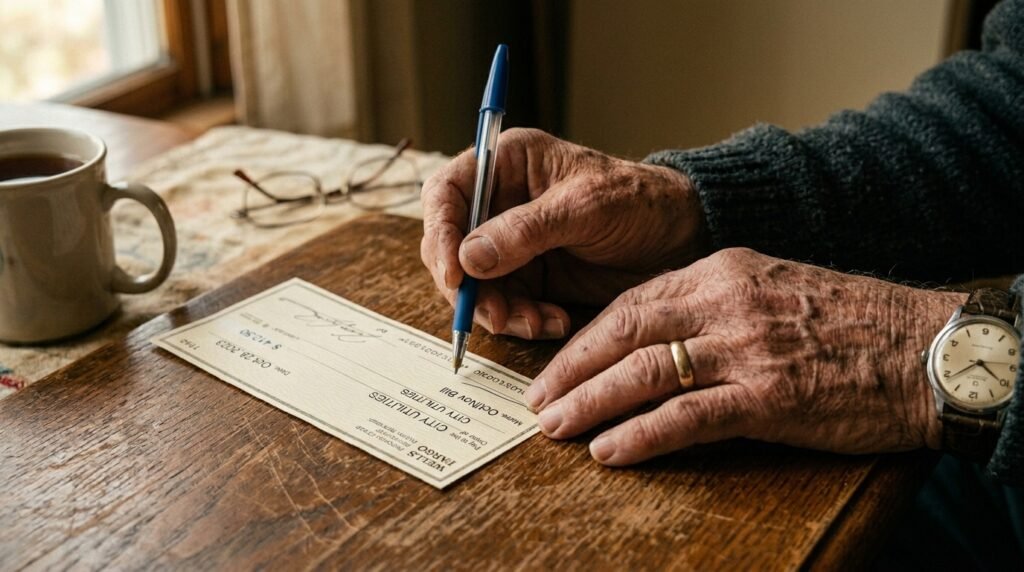
The Behavioral and Psychological Profile Criminals Exploit
Check washing criminals are not random opportunists. They are deliberate, and they know exactly who they are looking for. Seniors consistently emerge as the primary victims of check fraud for a set of very specific reasons that law enforcement agencies have documented repeatedly.
1. Seniors write far more paper checks than any other age group.
According to data analyzed in FinCEN’s 2023 alert on mail theft-related check fraud, older Americans continue to rely heavily on paper checks for routine bill payments — utilities, charitable donations, rent, medical bills, and personal gifts. Every paper check that leaves a home is a potential target. The more checks a person writes, the wider the window of exposure.
2. Trust in the postal system runs deep — and criminals exploit it.
The USPIS has noted in its consumer fraud advisories that older adults developed their habits during an era when the postal system was essentially the only option for secure remote payment. That deeply ingrained trust — entirely reasonable for decades — now creates a behavioral vulnerability: many seniors deposit outgoing mail in residential mailboxes or blue USPS collection boxes without awareness of how extensively those boxes are now being targeted by organized theft rings.
3. Seniors are less likely to monitor bank accounts digitally and in real time.
The FBI’s Internet Crime Complaint Center (IC3) has consistently found that older adults are less likely to use mobile banking apps or set up real-time transaction alerts — meaning check fraud can go undetected for days or weeks. This matters enormously because banks typically require fraud to be reported within 30 days of the statement date for full legal protection under the Uniform Commercial Code (UCC).
4. Larger balances and established accounts make seniors more attractive targets.
Retired seniors often have more predictable, stable bank balances than younger adults. Criminals who intercept a check can see the bank account number, the routing number, and the check amount — and use that information to estimate whether an account is worth targeting for a higher-value rewrite.
5. Social isolation reduces the chance of early discovery.
The FBI’s Elder Fraud Report has repeatedly highlighted that seniors who live alone or have limited daily social contact are less likely to have someone who notices irregularities in their finances quickly. Fraud that goes unreported for 30 days or more dramatically reduces the chance of financial recovery.
The bottom line: Check washing criminals follow the path of least resistance toward the highest reward. For these fraudsters, seniors represent exactly that combination. Understanding this is not about blame — it is about awareness, and awareness is the first step toward protection.
Section 2: How Check Washing Works — The Anatomy of the Scam
From Your Mailbox to a Criminal’s Bank Account
Check washing sounds almost too simple to be a billion-dollar crime. But its simplicity is precisely what makes it so devastatingly effective. Here is exactly how it works, step by step.
Step 1: Theft from the mail.
Criminals steal outgoing checks in one of two primary ways. The first is fishing from blue USPS collection boxes — a technique the USPIS has documented extensively, in which criminals use a sticky trap (often a glue-covered device lowered by string) or a stolen USPS “arrow key” (a master key for collection boxes) to pull envelopes out of public mail drops. The second is residential mailbox theft, in which criminals walk or drive through neighborhoods and pull outgoing mail — often flagged with a raised red flag — directly from home mailboxes. The USPIS has explicitly warned that raised mailbox flags are effectively a theft advertisement on streets being monitored by organized fraud rings.
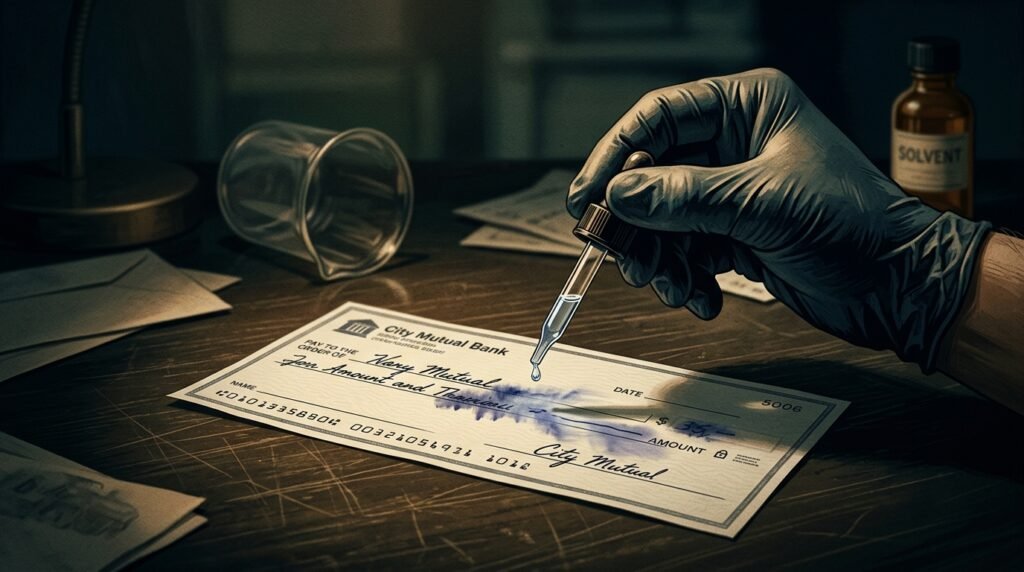
Step 2: Erasing the ink — the “washing” process.
Once a check is stolen, criminals use common household chemicals to erase the ink already on the check. The most frequently cited solvents in law enforcement reports include acetone (found in nail polish remover), bleach-based solutions, and other commercially available chemicals that lift standard ballpoint pen ink from paper without visibly damaging the check’s printed background, the MICR (Magnetic Ink Character Recognition) line at the bottom, or the authorized signature.
The result is a check that is chemically blank in the amount and payee fields — but still bears your real signature, your real bank account number, your real routing number, and the legitimate check stock.
Step 3: Rewriting the check.
With the fields now blank, the criminal rewrites the payee name (usually to themselves or an associate, or to a fictitious name with a matching fake ID) and inflates the dollar amount — often dramatically. A check written for $45 can be rewritten as $4,500. A check for $320 becomes $32,000. The forged check is then deposited — frequently through mobile check deposit or an ATM, using fraudulent accounts specifically opened for this purpose — and the funds are withdrawn quickly before the fraud is detected.
Step 4: You get the bank statement. The money is gone.
By the time most victims discover the fraud, the funds have been moved multiple times and the criminal has disappeared. Recovery is possible — but it depends critically on how quickly the fraud is reported to the bank, and that timeline is where many seniors lose their protection.
Key fact from FinCEN: The agency’s 2023 alert noted that many of the fraudulent checks being processed had been chemically altered so skillfully that standard bank teller review could not detect them. This is not a scam that can be caught by the naked eye — prevention must happen before the check leaves your hands.
Section 3: 4 Definitive Ways Seniors Can Prevent Check Washing

Your Complete Action Plan, Starting Today
The good news is this: check washing is almost entirely preventable. You do not need to be a cybersecurity expert or a fraud investigator to protect yourself. The following four strategies, implemented consistently, create a layer of protection that makes you an extremely difficult target.
Prevention Tip #1: Ditch the Ballpoint Pen — Switch to a Gel Ink Pen Immediately
This is the single most important physical security step you can take, and it costs less than $3.
Not all ink is created equal when it comes to check fraud resistance. Standard ballpoint pen ink sits on top of paper fibers, which means it can be lifted cleanly with chemical solvents. Gel ink, by contrast, penetrates and bonds with the cellulose fibers of the paper itself. When criminals attempt to apply acetone or bleach to a gel-ink check, the ink cannot be cleanly removed without also visibly destroying the paper — which makes the tampering obvious to any bank reviewer.
The USPIS has specifically recommended the use of pigmented gel ink pens for writing all checks. The most widely cited and specifically recommended model in fraud prevention literature is the Uni-ball 207 — a widely available, affordable gel pen that uses a pigmented ink formula engineered to trap in paper fibers and resist chemical erasure.
Here is exactly what to do:
- Go to any office supply store (Staples, Office Depot) or order online and purchase a Uni-ball 207 (look for the “fraud prevention” language on the packaging — Uni-ball markets this pen specifically for this purpose) or a comparable pigmented gel ink pen. Avoid “gel pens” that are water-based and not pigmented — they do not offer the same protection.
- Use this pen exclusively for writing checks. Every line — the date, the payee name, the amount in numerals, the written-out dollar amount, and the memo line.
- Fill in all blank spaces on the check. Draw a line through any empty space after the payee name and after the written dollar amount. Leave no blank area that a criminal could use to add characters or change amounts.
- Press firmly when writing. Gel ink bonds better when applied with consistent downward pressure that pushes ink deeper into the paper fibers.
Pro tip: Write the amount as far to the left as possible in the dollar box, and draw a line immediately after the final digit (e.g., “187.00—”). This eliminates space for a criminal to add digits before or after your amount.
Prevention Tip #2: Rethink How You Mail Checks — Postal Security Is Everything
How you mail a check matters as much as what you write it with. The USPIS has issued repeated public advisories urging Americans to change their mailing habits — and these recommendations are worth taking seriously and sharing with every senior you know.
Never use your home mailbox for outgoing checks.
The USPIS is explicit on this point: do not leave outgoing mail containing checks in your residential mailbox for carrier pickup, especially not overnight or on weekends. Organized theft rings specifically drive through residential neighborhoods targeting raised-flag mailboxes. Your mail carrier is only one of many people who pass your mailbox daily.
Avoid blue collection boxes after business hours.
If you use a USPS blue collection box, deposit your mail only during the day, and only in boxes located near a post office or in high-traffic, well-lit, frequently serviced locations. Boxes in low-traffic areas are targeted more frequently because they are serviced less often (sometimes only once daily), giving criminals a larger window. The USPIS has documented widespread use of stolen USPS arrow keys — master keys that open collection boxes — by organized mail theft rings operating across the country.
Here is exactly what to do:
- Take checks directly inside the post office and hand them to a clerk at the counter. This is the most secure method available. The check goes from your hands directly behind the counter — no mailbox, no outdoor drop.
- Use USPS Certified Mail or First-Class Mail with a tracking number for any check that is large or particularly important. Certified Mail requires a signature at delivery and creates a documented chain of custody.
- Never leave outgoing mail in your home mailbox overnight or over a weekend. If you miss the day’s pickup, hold the envelope until the next morning and either take it inside a post office or hand it directly to your mail carrier.
- Consider signing up for USPS Informed Delivery at informeddelivery.usps.com (it is free). This service sends you a daily email with grayscale images of the mail pieces expected to arrive in your mailbox that day. While it does not prevent theft, it tells you when something expected has not arrived — a critical early warning sign.
USPIS reminder: The agency urges Americans to report mail theft immediately by calling 1-877-876-2455 or filing a report online at postalinspectors.uspis.gov. Every report helps federal investigators track theft ring patterns and locations.
Prevention Tip #3: Monitor Your Bank Account Every Single Day — Know Your Legal Deadline
Catching check washing fraud early is not just smart — under US law, it can be the difference between getting your money back and losing it permanently.
Here is the legal reality that every senior and every adult child of a senior needs to understand: Under the Uniform Commercial Code (UCC), which governs banking transactions in all 50 states, you generally have 30 days from the date your bank statement is sent to report an unauthorized or altered check. If you miss that window, most banks are legally entitled to deny your claim — and many do.
Some banks enforce even shorter internal windows for reporting certain types of fraud. The FBI’s Elder Fraud division has highlighted that delayed discovery of check fraud — particularly common among seniors who review paper statements monthly rather than monitoring accounts in real time — is one of the primary reasons elderly victims fail to recover their funds.
Here is exactly what to do:
- Log in to your bank account online every single day — or ask a trusted adult child or family member to help you set this up. Most major US banks offer free online and mobile account access. You are looking for any check cleared that you do not recognize, any amount that does not match your records, or any payee name that is wrong.
- Set up account alerts immediately. Call your bank’s customer service number or visit a branch and ask them to activate real-time text or email alerts for every check that clears your account. Most major banks offer this at no charge. You will receive a notification the moment any check is cashed — giving you same-day awareness rather than monthly.
- Keep a physical check register. This is a habit many seniors already have — and it is genuinely valuable for fraud detection. Every check you write should be logged with the date, check number, payee, and amount. Any discrepancy on your bank statement stands out immediately.
- If you see something wrong, call your bank the same day. Do not wait. Do not assume it is a mistake that will resolve itself. Call the fraud line on the back of your debit card immediately, state that you believe you are a victim of check washing, and ask them to freeze the account and begin a fraud investigation. Then file a report with the USPIS at postalinspectors.uspis.gov and with the FTC at reportfraud.ftc.gov.
Important: If you believe a check was stolen from the mail — not just altered — also contact your local US Postal Inspector, as mail theft is a federal crime under 18 U.S.C. § 1708, carrying penalties of up to five years in federal prison for perpetrators.
Prevention Tip #4: Transition Away from Paper Checks — Use Electronic Payments Where Possible
The most complete protection against check washing is eliminating the physical check whenever possible. This is not about abandoning everything familiar — it is about strategically reducing your exposure to a known and growing threat.
The USPIS, the FBI, and FinCEN all point to the growth of electronic payment options as a structural solution to mail theft-related check fraud. When there is no paper check to steal, there is nothing to wash.
Here is exactly what to do — one step at a time:
- Set up automatic electronic bill pay for recurring bills. Most banks offer free Bill Pay services through their online banking portal. You can schedule recurring payments for utilities, insurance premiums, mortgage or rent, and medical bills — all without writing a single check. Call your bank’s customer service line and ask them to walk you through the setup, or visit a branch and ask a banker to help you in person.
- Ask billers to switch you to ACH (Automated Clearing House) payments. ACH is the electronic network that handles direct deposits and direct debits between bank accounts. When you pay a utility, insurance company, or subscription service via ACH, the payment moves electronically and securely between accounts — with no physical document that can be intercepted or altered.
- Use direct deposit for any incoming payments. If you receive Social Security, pension income, or any other recurring payment by paper check, contact the issuing agency and request direct deposit. For Social Security specifically, call 1-800-772-1213 or visit your local Social Security Administration office. Direct deposit eliminates the risk of incoming check theft as well.
- For one-time payments to people you trust, consider alternatives to paper checks: Zelle (available directly through most major bank apps with no fee), PayPal, or bank wire transfers for larger amounts.
- If you must write a paper check, apply all the protections from Tips #1 and #2 above: gel ink pen, hand-deliver to a post office counter, monitor your account the same day the check should clear.
A note for adult children: If your parent is not comfortable with online banking, this is one of the most valuable things you can do for them. Offer to sit down together, set up their online account access and transaction alerts, and show them how to check their balance each morning. Fifteen minutes of your time could save them thousands of dollars — and months of heartache.
Conclusion: Share This — Because One Conversation Could Save a Loved One’s Life Savings
Check washing is not a sophisticated, high-tech scam. It does not require a computer, a hacker, or a data breach. It requires only a stolen envelope, a bottle of nail polish remover, and a criminal willing to exploit the everyday habits of trusting Americans.
But here is the empowering truth: it is almost entirely preventable.
Let’s recap the four steps that form your complete protection plan:
- Switch to a Uni-ball 207 or pigmented gel ink pen for every check you write — it makes the check chemically resistant to erasure.
- Hand-deliver outgoing mail with checks directly to a post office counter — never leave checks in a residential mailbox or blue collection box overnight.
- Monitor your bank account daily and set up real-time check alerts — and know your 30-day legal deadline for reporting fraud.
- Transition to electronic bill pay and ACH payments wherever possible — eliminating the paper check eliminates the risk.
None of these steps requires a technology degree. None of them are expensive. All of them are grounded in guidance from the United States Postal Inspection Service, the FBI, and the Financial Crimes Enforcement Network — the federal agencies who investigate these crimes every single day.
Your call to action: If you read this article and someone you love came to mind — a parent, a grandparent, a neighbor, an aunt or uncle who still mails their bills with a ballpoint pen and a raised mailbox flag — please share this article with them today. Print it out if that is what it takes. Read it with them over the phone. Post it on your social media.
One conversation could save someone’s life savings.
And if you or someone you know has already been targeted, report it immediately:
- US Postal Inspection Service: postalinspectors.uspis.gov or 1-877-876-2455
- FBI Internet Crime Complaint Center (IC3): ic3.gov
- FTC Fraud Report: reportfraud.ftc.gov
- Your state’s Attorney General consumer fraud division
You are not powerless against check washing. You are just one gel pen, one phone call, and one login away from being protected.
There have actually been cases where people paid their taxes to the IRS by check but were hit with heavy penalties for alleged non-payment. Therefore, to protect yourself from credit card fraud, the most important step is to use a long PIN whenever possible. Please also be cautious of fraud, as even postal workers can sometimes be involved in scams.
Found this guide helpful? Share it with every senior in your life — and leave a comment below with any questions. We read every one.
Sources & Authoritative References:
- US Postal Inspection Service (USPIS) — Mail Theft & Check Fraud Advisories: postalinspectors.uspis.gov
- Financial Crimes Enforcement Network (FinCEN) — Alert on Mail Theft-Related Check Fraud (2023): fincen.gov
- FBI Elder Fraud Report (annual): ic3.gov/Media/PDF/AnnualReport
- FBI Internet Crime Complaint Center (IC3): ic3.gov
- Federal Trade Commission (FTC) — Check Fraud Resources: consumer.ftc.gov
- USPS Informed Delivery (free enrollment): informeddelivery.usps.com
- HUD Location Affordability Portal: locationaffordability.info
- Federal statute on mail theft: 18 U.S.C. § 1708
- Uniform Commercial Code (UCC) Article 4 — Bank Deposits and Collections
Leave a Reply